
What Are the Top 10 Signs of Magnesium Deficiency in Crops?
Yellow leaves are one of the most misread symptoms in agriculture — and one of the most costly to misread. When older leaves turn yellow between green veins, the cause is usually magnesium deficiency, not nitrogen. This article lists the 10 field signs that give it away, explains how to correct it fast with magnesium sulfate, and shows how to keep it from coming back next season.

Table of Contents
- Why Does Magnesium Deficiency Show Up on Old Leaves First?
- The Top 10 Signs of Magnesium Deficiency — A Field Checklist
- Fast Correction: How to Turn Yellow Leaves Green Again
- Long-Term Prevention: Put Magnesium on the Fertilization Calendar
- Frequently Asked Questions
- Conclusion
Why Does Magnesium Deficiency Show Up on Old Leaves First?
Magnesium is one of the plant's most mobile nutrients. When roots cannot take up enough of it, the plant does something remarkable: it strips magnesium out of the older leaves and reroutes it to the growing points, young leaves and fruit.
That single mechanism explains two patterns you will see in the field:
- New leaves green, old leaves yellow. A mobile nutrient like magnesium runs out in the oldest tissues first. Iron deficiency behaves the opposite way — it hits the youngest leaves while old ones stay green.
- Heavier crop, faster yellowing. Fruit is the biggest sink for magnesium. During bulking, magnesium pours into the fruit, and lower leaves show the shortage first — often exactly when the crop needs photosynthesis most.
Once this logic is clear, field diagnosis gets much easier.
The Top 10 Signs of Magnesium Deficiency — A Field Checklist
- Interveinal chlorosis on older leaves: green veins, yellow tissue between them, forming a clear "rib-bone" pattern.
- Yellowing starts between the midrib and the secondary veins, then spreads outward toward the leaf margins.
- In severe cases, necrotic patches appear between the veins while the main veins stay green.
- Premature leaf drop — the lower stem gradually turns bare ("flagging" up the plant).
- Uneven fruit coloring, slow ripening, low sugars and flat flavor.
- Slow fruit expansion and lower average fruit weight; more small, unmarketable fruit.
- More flower and fruit drop; fruit set visibly below the field's potential.
- Weak stems and premature senescence, shortening the productive window.
- Potatoes: restricted tuber bulking and dull skin. Sugarcane and sugar beet: lower sugar content.
- In the same field, magnesium-hungry crops (citrus, tomato, potato) show symptoms while cereals beside them still look fine.
A quick mnemonic to carry into the field: old leaves, green veins, rib-bone pattern, worst at fruiting — see all four, and you are almost certainly looking at magnesium deficiency.
Fast Correction: How to Turn Yellow Leaves Green Again
Step 1: Rule out the lookalikes.
Check roots first. Waterlogging, root rot and nematodes all block nutrient uptake, and no fertilizer fixes a rotten root. If roots are white and healthy, move to the next step.
Step 2: Foliar spray to rescue.
Mix a 0.5–1% magnesium sulfate solution (about 50 g per 10 L of water at 0.5%). Spray until leaves are wet on both surfaces, focusing on the affected lower leaves. Repeat once after 7–10 days — greening typically shows within 5–7 days.
Step 3: Soil application to fix the cause.
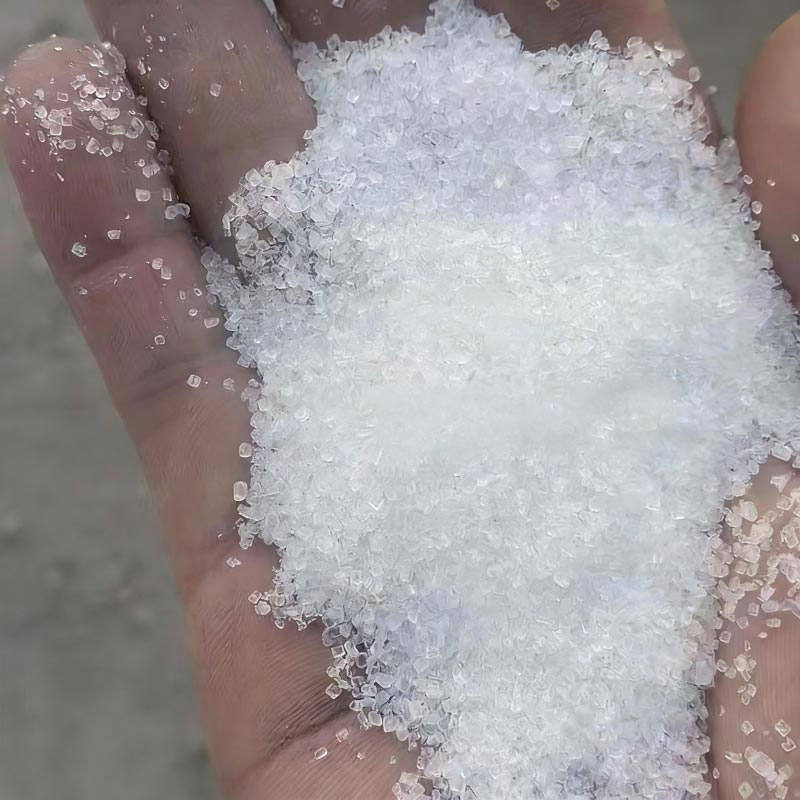
Spraying treats the symptom; the soil treatment cures it. Apply agricultural-grade magnesium sulfate by band or through the irrigation system so the plant has a steady Mg supply well into the season.
Step 4: Monitor and verify.
Watch the next flush of leaves. If symptoms return on new growth, soil reserves are badly depleted (or potassium is out of balance) — a full-season Mg program is needed.
Long-Term Prevention: Put Magnesium on the Fertilization Calendar
Test soils every year. Ask specifically for exchangeable magnesium and the K:Mg ratio — both are routinely skipped in standard reports.
Feed high-demand crops every season. Citrus, tomatoes, potatoes, bananas and tea should get Mg annually — before symptoms, not after.
Keep potassium in balance. High-K orchards are the most common victims; K and Mg must be managed together.
Build organic matter. It improves the soil's ability to hold magnesium, especially on sand.
Choose a stable supplier. Consistent quality and batch testing matter more than the lowest price per bag — magnesium sulfate heptahydrate with a certificate of analysis is the floor, not the ceiling.
Frequently Asked Questions
Q1: After spraying, how long until leaves turn green?
Under good conditions, greening is visible within 5–7 days; full recovery takes 2–3 weeks. If nothing changes after two weeks, re-check the roots or the K:Mg balance rather than spraying again.
Q2: How do I tell magnesium deficiency from iron deficiency?
Position tells the story: magnesium hits old leaves (yellow between green veins); iron hits new leaves (whole leaf pale or white). They can occur together — test by spraying each nutrient separately.
Q3: How much magnesium sulfate should I apply per hectare?
Typical base rates: 150–225 kg/ha for field crops, 120–180 kg/ha for vegetables, and 0.5–2 kg per tree for orchards. Always fine-tune with soil tests and target yields.
Q4: What should I look for when choosing agricultural magnesium sulfate?
Four things: declared MgO and sulfur content, low water insolubles (critical for drip systems), a batch-level COA, and heavy metals within limits. A stable product source beats an aggressive bargain every season.
Conclusion
"Old leaves, green veins" is your crop's clearest distress signal — and one of the easiest to answer correctly. Diagnose carefully, rescue with a foliar spray, secure the season with a soil application, and plan prevention into every fertilization calendar. Four steps, done consistently, keep the green in the leaves and the yield in the bin.
If you are looking for a reliable agricultural magnesium sulfate supplier that offers consistent quality and professional support, Tianjin Rongda Fertilizer Co., Ltd. is ready to help. Contact us today to learn how our fertilizer solutions can improve your agricultural productivity.
Related News
- How Do Water-Soluble Fertilizers Feed Drip-Irrigated Crops?
- What Can Calcium Magnesium Granules Do for Degraded and Acid Soils?
- Why Do Modern Crops Need More Sulfur Than NPK Provides?
- How to Apply Magnesium Sulfate to Orchards, Vegetables & Field Crops?
- Is Calcium Ammonium Nitrate a Safer Nitrogen for Stressed Soils?
- Why Is Magnesium Sulfate the Fourth Major Nutrient for High Yields?
Leave me a message